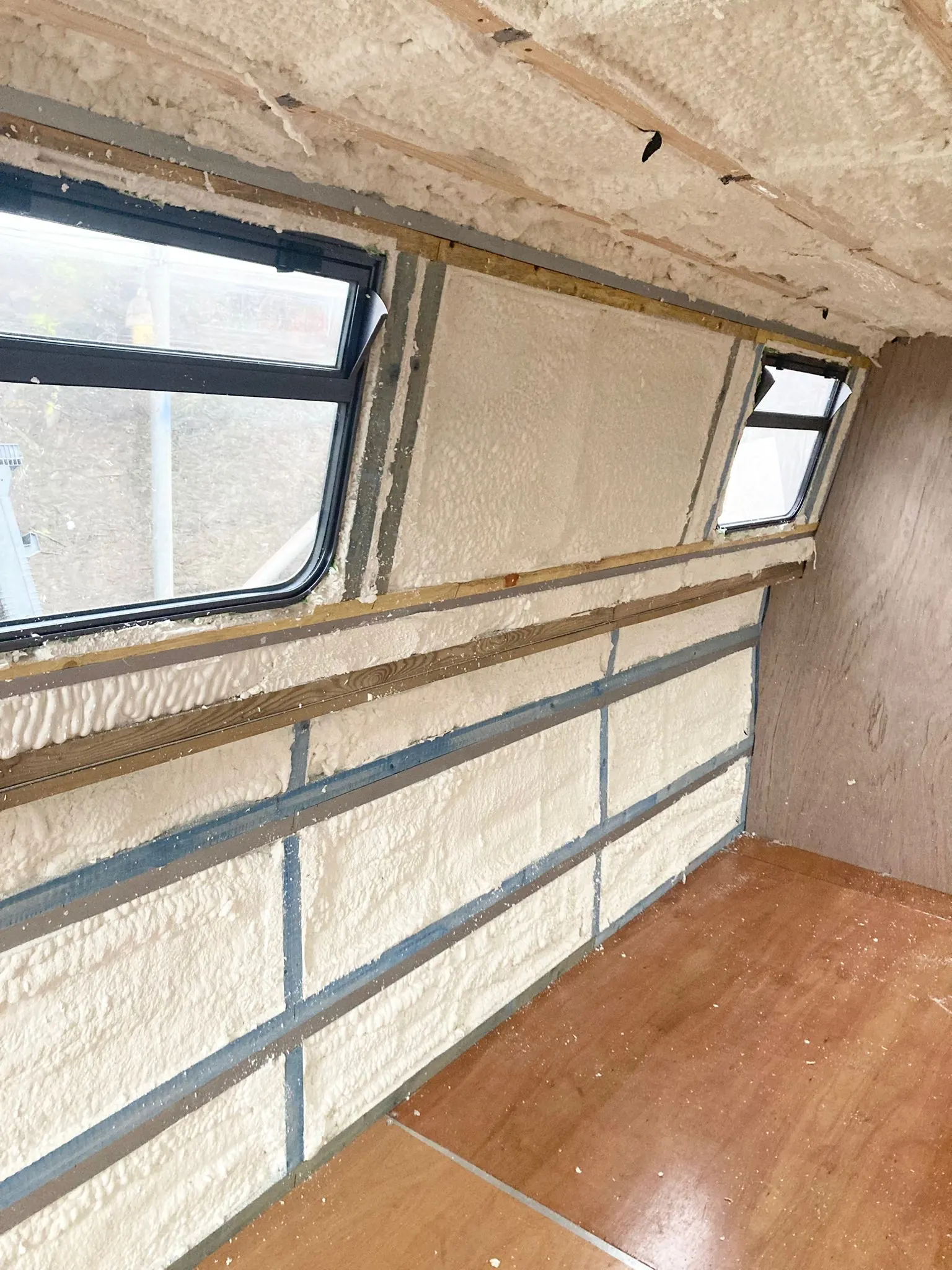
Canal Boat Spray Foam Insulation
Commercial canal boat spray foam insulation for steel craft and hire fleets — closed-cell Enverge foam beats hull sweating and condensation, keeping cabins dry, warm and fit-out ready across the whole fleet.

Why spray foam for canal boats
A steel canal boat is essentially a thin steel skin between a warm cabin and cold water. That skin is a continuous cold bridge, and without proper insulation, warm cabin air condenses on it — the familiar 'hull sweating' that soaks linings, corrodes steel from the inside and leaves bilges wet. Closed-cell spray foam tackles this at source by warming the internal surface and sealing it against moisture in one operation.
For fleet operators, consistency matters as much as performance. Spraying Enverge closed-cell foam gives every boat the same monolithic, self-bonded insulation layer regardless of cabin shape or fit-out stage. There are no batts to compress, slip or leave gaps, and no mechanical fixings to work loose with the constant vibration and flexing of a working craft moving lock to lock.
ThermoFoam fits in with builders' and operators' programmes, spraying at the fit-out or re-fit stage before joinery goes back. The foam is sprayed onto prepared bare steel, expands to seal every rib and curve, then is trimmed flush so battens, ply and linings can be installed straight over it — keeping the fleet's turnaround tight between seasons and charters.
The benefits for canal boats
One Fleet Spec
Apply the same closed-cell insulation across every boat for consistent warmth, dryness and predictable re-fit life.
Beats Hull Sweating
Warms the internal steel surface above dew point so condensation stops forming on cabin sides and the baseplate.
No Fixings To Loosen
Foam self-bonds to the steel and won't slip, compress or work loose under the constant flex of a working craft.
Fit-Out Ready
Sprayed and trimmed flush so battens, ply and linings install straight over it, keeping fleet turnaround tight.
Protects The Asset
A dry, sealed hull resists internal corrosion and rot, extending the working life of each boat in the fleet.
Low Maintenance
Rigid, durable closed-cell foam needs no upkeep between charters, ideal for hard-worked hire and commercial craft.
Fleet-Grade Hull Insulation
Operators running multiple steel canal boats need one consistent, durable insulation spec across the fleet. Our closed-cell Enverge foam self-bonds to each bare hull, sealing cabin sides and baseplate against the cold water line so every boat handed back to a hirer is dry, warm and free of the hull sweating that drives re-fit costs.
Sprayed onto prepared bare steel, Enverge closed-cell foam expands and self-bonds to the canal boat hull, forming a rigid, low-permeability layer over cabin sides, baseplate and ribs. Raising the internal steel surface above the cabin dew point removes the cold surface that drives hull sweating — delivered to one repeatable spec across an entire fleet.
- One consistent closed-cell spec across the whole fleet
- Self-bonds to bare steel — no slipping batts or fixings
- Stops hull sweating and protects against internal corrosion
- 25-year manufacturer-backed product warranty
Enverge Nexseal LE — verified performance
Typical published values for Enverge Nexseal LE closed-cell foam. Full technical specification →
Specification & compliance for canal boats
Steel hulls sweat: warm cabin air meets cold plate and condenses, corroding the vessel from the inside and soaking fit-outs. Closed-cell foam sprayed at 25–75 mm bonds directly to the hull and deckhead, following every curve, rivet and weld — surfaces rigid boards simply can't follow — and carries its own vapour barrier, so no separate membrane is needed.
Most narrowboats, widebeams and workboats are completed in one to two days. The foam adds rigidity, keeps condensation off the steel permanently, and is backed by a 25-year manufacturer product warranty.
From enquiry to warranty
Enquire
Tell us about your canal boats & building.
Survey
Free survey of your canal boats & condensation check.
Specify
The right system for your canal boats.
Install
Approved applicators, minimal disruption.
Warranty
Handover pack & 25-year warranty.
Real canal boats spray foam applications


Commercial projects

University Hospital of Wales
Low-odour, fully documented install in a live healthcare site.

Derriford District Centre
Spray foam insulation for a busy public-sector building.

Newport Leisure Centre
Pool-hall insulation controlling humidity and heat loss.
Get a quote for your project
Send us your building details and our technical team will specify the right system and a clear budget. No obligation.
Canal Boat insulation, answered
Why do canal boats suffer from hull sweating?
The steel hull sits in cold water while the cabin is warm and humid, so the inner steel face stays cold and cabin moisture condenses on it. Closed-cell spray foam raises that surface temperature above dew point, removing the cold face the condensation needs to form.
Can you insulate a whole hire fleet to one spec?
Yes — that's a core reason operators choose spray foam. Every hull gets the same self-bonded, seamless closed-cell layer regardless of cabin shape, giving consistent warmth, dryness and re-fit life across the fleet rather than the variability of hand-fitted batts.
Will the foam handle the vibration of a working boat?
It's well suited to it. Because the foam self-bonds to the steel as it cures rather than relying on fixings or battens, there's nothing to slip, compress or work loose as the craft flexes through locks and runs lock to lock all season.
When in the build is the foam applied?
At fit-out or re-fit, before joinery goes back. We spray onto prepared bare steel, the foam expands to seal every rib and curve, then it's trimmed flush so battens, ply and linings fit straight over it — keeping fleet turnaround tight between charters.
What certification and warranty come with it?
The Enverge closed-cell system (Nexseal LE) is supplied with Duratite as the UK distributor of record. It carries a 25-year manufacturer-backed product warranty — never insurance-backed — so fleet operators have long-term assurance on every boat.
How long does boat insulation take?
Most vessels are sprayed in 1–2 days depending on size and access — far faster than batten-and-board methods.
Will it stop hull condensation completely?
Yes — closed-cell foam seals the steel so warm cabin air never reaches a cold surface, stopping the sweating that drives corrosion.
What depth is applied to a hull?
Typically 25–75 mm depending on the vessel and how it's used — specified after survey.
Insulate your canal boats the right way
Specialist commercial spray foam, installed UK-wide by the Duratite Group's spray foam specialists.
Book a Free Survey →or call 01208 832 602