Updated 22 September 2026 · ThermoFoam
Choose a complete construction, not a winning material
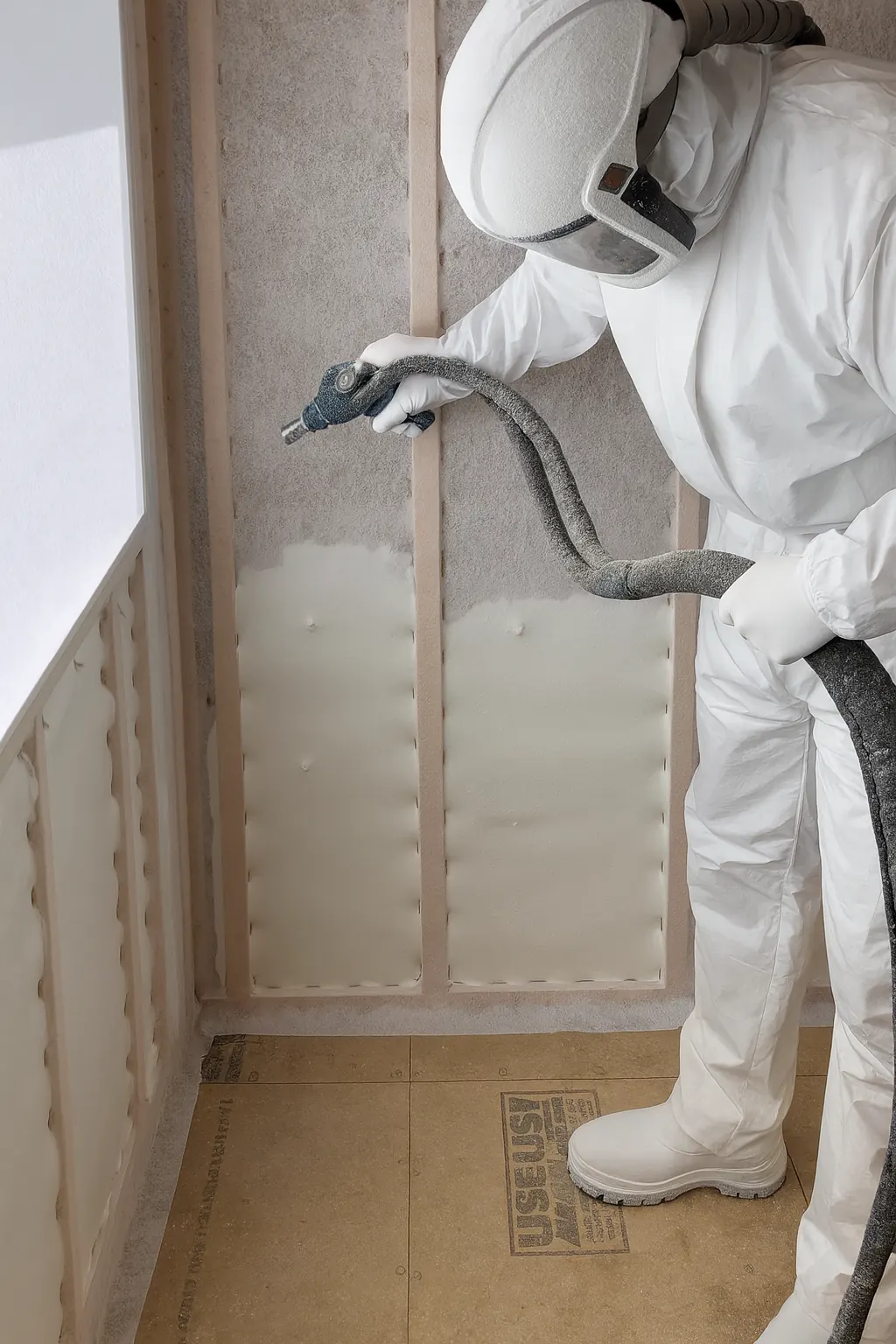
Spray foam, PIR boards and mineral wool can all have roles in commercial insulation. The right choice depends on the substrate, thermal target, moisture design, fire requirements, access and future maintenance. No material is the best answer for every building.
This comparison concerns commercial applications. It is not a recommendation to retrofit a domestic pitched roof without assessing its construction, condition and other project requirements.
Spray foam, PIR board and mineral wool compared
| Decision | Closed-cell spray foam | PIR board | Mineral wool |
|---|---|---|---|
| Shape and fit | Applied on site to follow suitable prepared profiles. Thickness and coverage need checking. | Preformed boards suit planned layouts; edges and penetrations need accurate cutting and detailing. | Available as batts, slabs or rolls for different assemblies; correct fit and support matter. |
| Air and vapour control | Continuity can help air control, but junctions and vapour design still need assessment. | Facings and joint treatments may form part of a designed air/vapour control layer. | Generally needs a separately designed air/vapour strategy within the construction. |
| Fire requirements | Check the product and complete assembly, including required protective coatings or linings. | Check the selected board, facings and complete assembly. | Non-combustible stone wool products are available; check the exact classification and assembly. |
| Future access | Bonded application can make later inspection or removal from treated surfaces more involved. | Access and replacement depend on fixings, finishes and the assembly. | Access and replacement depend on supports, linings and the assembly. |
| Installed cost | Include preparation, work-zone controls, thickness and any finish. | Include fixings, cutting, joint treatment, access and any finish. | Include supports, fit, membranes, access and any finish. |
Compare U-values and details, not equal thickness alone
Thermal conductivity describes a material. A U-value describes heat transfer through a construction. Two different products at the same thickness do not necessarily provide the same thermal resistance, and junctions or fixings can affect overall performance.
Compare calculated performance for the proposed build-up, using the selected products’ declared data. Include beams, slab edges and other thermal bridges where relevant. Our Nexseal LE product page provides typical published material information, not a completed roof calculation.
Moisture and fire requirements can determine the choice
Every option needs a moisture strategy. Correctly installed board or mineral wool systems should not be dismissed as inevitably leaky, sagging or condensation-prone. Equally, spray foam should not be assumed to eliminate all thermal bridges or remove the need for ventilation.
For fire, distinguish a product reaction-to-fire classification from the fire resistance of a complete element. The relevant evidence must cover the selected assembly and project requirements. A coating name alone is not enough to establish a fire rating.
Existing roofs need a condition and maintenance review
Before choosing insulation, establish the condition of sheets, concrete, coatings and supporting structure. Plan repairs before covering a surface. Decide which areas must remain accessible for inspection or future work.
Bonded foam follows suitable profiles, but it also changes how the substrate can be inspected and removed. Boards and slabs bring different fixing, joint and access requirements. Agree these trade-offs with the designer and building owner instead of treating them as afterthoughts.
A soffit example with a recorded protective finish
The Pondswick substation case study shows an insulation application followed by a protective coating. It illustrates why the complete finish belongs in the specification; its recorded build-up is not a universal design for all soffits.
Questions to ask before selecting an insulation system
What thermal performance is required? What moisture and fire evidence supports the assembly? Which surfaces need to remain accessible? What preparation, fixing or protection is included? How will the occupied site be managed?
Ask for like-for-like quotations against that brief. Our commercial insulation cost guide provides a comparison checklist. For your own building, send the project details and discuss the scope.
Product information to check
Use the current documentation for the exact product and application. Useful starting points include ROCKWOOL product documentation, Kingspan Thermapitch TP10 design and installation guidance, and Enverge Nexseal LE information. These examples do not make the products interchangeable.
Application photography