
The challenge of temperature-controlled buildings
Cold stores, food production areas, chilled warehouses and other temperature-controlled buildings work hardest to hold a stable internal environment against the outside climate. Every gap, junction and fixing in the envelope is a potential path for heat transfer and, critically, for moist air that can lead to condensation.
Conventional board insulation relies on many joints and fixings, each a possible weak point. For demanding temperature-controlled applications, a continuous, well-sealed envelope is far preferable. This is where closed-cell spray foam, applied as a seamless layer, offers genuine advantages over piecemeal systems.
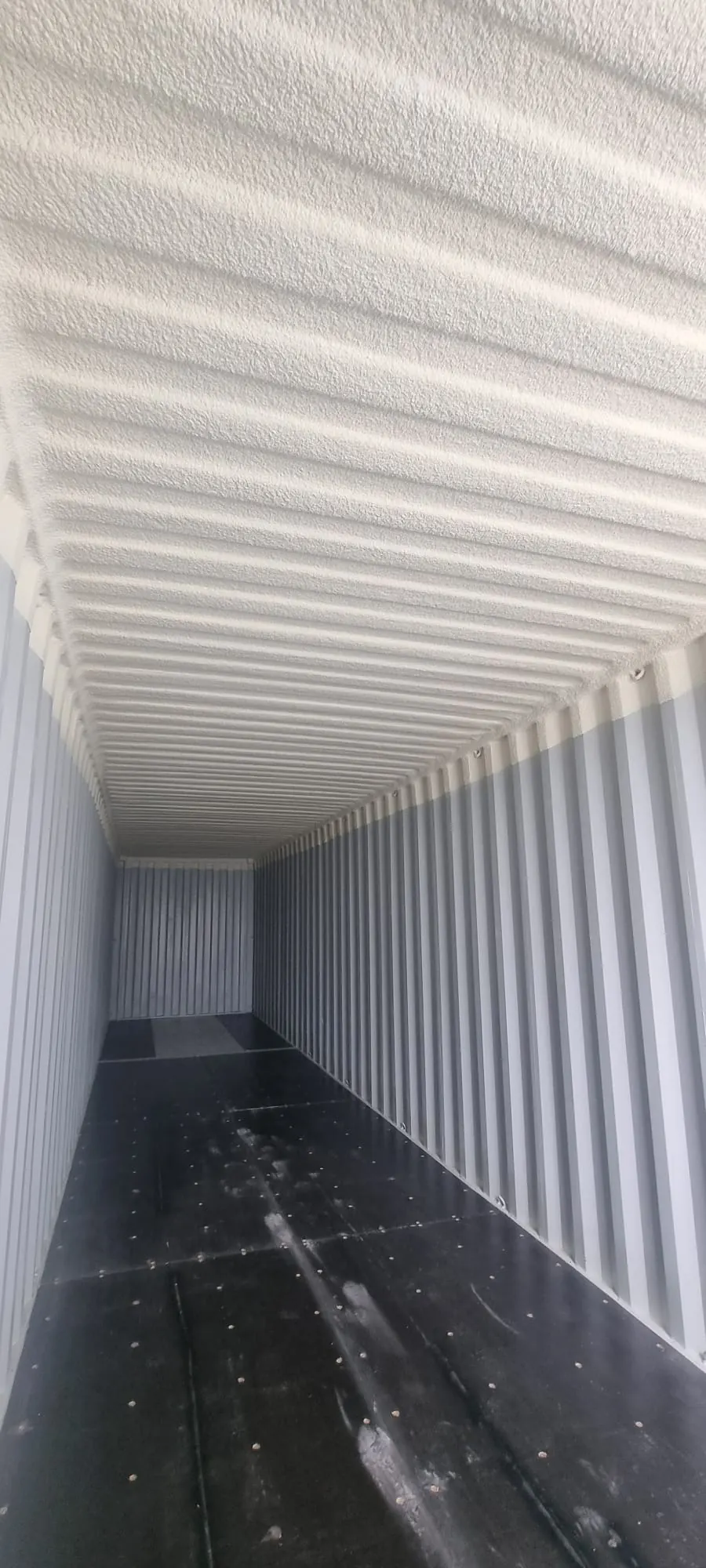
How closed-cell spray foam helps
Closed-cell spray foam is sprayed on site and self-bonds to the substrate as it cures, forming one continuous layer that follows the building's shape. There are no boards to fix, no repeating joints and no reliance on mechanical fasteners that interrupt the insulation line.
That seamless coverage combines insulation and air-sealing in a single application. Reaching into awkward junctions, around steelwork and across irregular surfaces, the foam closes the gaps that often undermine temperature control in cold storage and chilled environments where consistency really matters.
- Seamless, continuous coverage with no repeating board joints
- Self-bonds to the substrate — no mechanical fixings interrupting the layer
- Combined insulation and air-sealing in one application
- Conforms to irregular surfaces, steelwork and difficult junctions
Continuous air-sealing and the building envelope
In temperature-controlled buildings, uncontrolled air movement is as damaging as poor insulation. Warm, moist air infiltrating a cold space — or cold air escaping — undermines stability and forces refrigeration plant to work harder than it should.
Because closed-cell spray foam seals as it insulates, it tackles both at once. A continuous air-tight layer reduces draughts and air leakage across the envelope, helping conditions stay consistent and supporting the efficient operation of cooling systems within the space.

Condensation and dew point control
Condensation is the defining risk in cold storage. Where warm, humid air meets a cold surface at or below the dew point, moisture forms — and over time that can cause dampness, corrosion and degraded performance. Managing where and whether surfaces reach dew point is essential.
Closed-cell spray foam's continuous, air-sealing nature helps limit the migration of moist air to cold surfaces within the envelope. By reducing uncontrolled air paths and providing seamless coverage, it supports a drier, more controlled internal environment. Every facility is different, so condensation risk should be assessed at survey stage.
Thermal stability for sensitive operations
Many temperature-controlled operations — food storage, processing and distribution among them — depend on holding conditions steady, not just cold. Fluctuations stress refrigeration plant and can affect stored goods, so a stable, predictable envelope is a real operational benefit.
A continuous, well-sealed insulation layer helps buffer the internal space against external swings, smoothing the demand placed on cooling systems. For chilled warehouses and cold stores, that stability supports both the integrity of operations and the consistent running of the equipment that maintains them.
Specification, certification and warranty
For cold storage, specification detail matters. ThermoFoam, part of the Duratite Group, installs Enverge closed-cell spray foam — trade name Nexseal LE — for which Duratite is the UK distributor of record. The system carries a 25-year manufacturer-backed product warranty.
Every temperature-controlled project should begin with a site survey to assess substrate, condition, ventilation and condensation risk, followed by a clear specification and method statement. Because these buildings are commercial and often operational, careful planning around access and continuity of cooling is part of getting the result right.